How to Handle Calls to Your Business after Business Hours?
Find out how to handle your customers' calls after hours, and how automated call services ensure no lead ever goes unanswered.
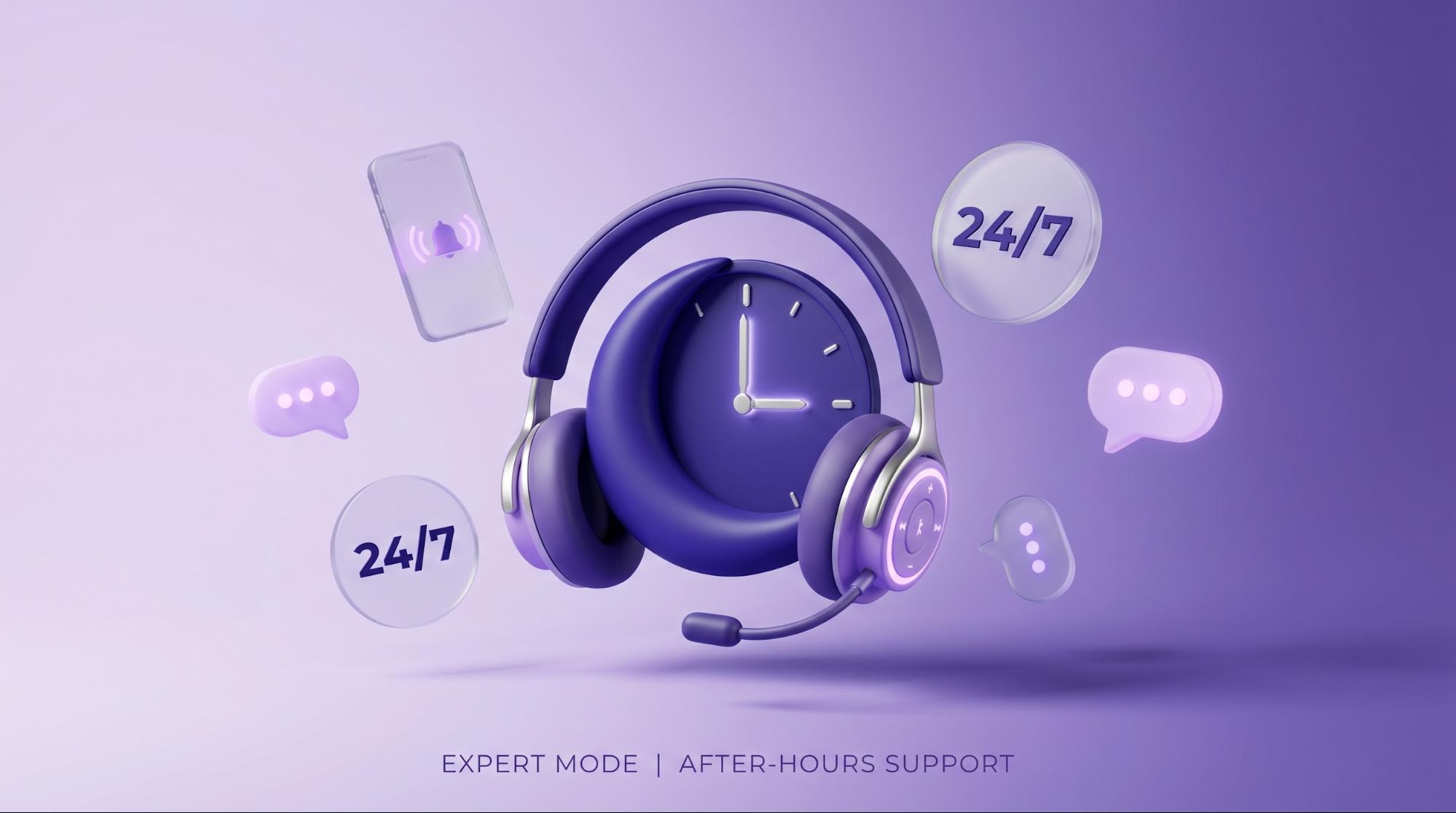
Most businesses think that their company grows slowly because they lag in marketing or their products fall behind in quality. However, the real silent killer of growth might be the simple, unanswered ring of a telephone after working hours. For most entrepreneurs, the workday ends, the lights go out, and the closed sign is flipped. Nonetheless, the modern consumer does not operate on a 9-to-5 schedule. In fact, a significant portion of high-intent leads reach out during their own downtime, lunch breaks, commutes, or late evenings. When those calls go unanswered, the potential customer doesn't just wait until the next morning; they move to the next name on the search results page. This detailed guide will explore the evolution of after-hours communication and how an automated call service can bridge the gap between your closing time and your next sale.
The After-Hours Call Problem for Small Businesses
Almost every business owner has felt that pang of regret upon seeing a missed call notification from a Saturday afternoon or a late Tuesday night. You know that behind every missed call is a potential contract, a loyal client, or an emergency service request. The reality of the modern marketplace is that accessibility is the new currency. We live in an era of instant gratification where a delay in response is often interpreted as a lack of professionalism or a lack of interest. If you are a small business owner, you likely don't have the bandwidth to be ON 24/7. Yet, if you aren't available, your competitors likely are. This creates a friction point: how do you maintain a personal life and operational efficiency while satisfying a market that never sleeps?
Traditional Solutions to Dealing with After-Hours Calls and Their Limitations
For decades, small businesses relied on a handful of standard methods to manage off-hours communication. However, as we move through 2026, the data suggests these methods are no longer sufficient to meet consumer expectations.
Historically, the answering machine was the gold standard. Unfortunately, the psychological barrier of the beep has never been higher. According to reports from Forbes, a staggering 80% of callers hang up when they encounter a voicemail greeting. Modern customers view voicemail as a black hole where information goes to die. They don't want to leave a message and hope for a callback; they want a conversation.
Additionally, the most direct solution is hiring a human to sit by the phone. However, the math rarely works for small and medium-sized businesses. As of May 2026, the average salary for a full-time receptionist in the US has climbed to roughly $47,000 annually. When you factor in the night shift differential, benefits, and payroll taxes, a dedicated after-hours role easily exceeds the $45,000–$60,000 range. For a business processing a handful of late-night inquiries, the Return on Investment (ROI) is simply nonexistent.
Many owners try to handle the burden themselves by forwarding business lines to their personal cell phones. While this ensures the call is answered, it leads to immediate entrepreneurial burnout. Furthermore, answering a professional inquiry while at dinner or in a noisy environment can actually damage your brand's reputation more than a missed call would.
Automated Call Services as a Modern Solution to Handling After-Hours Calls
To address the cost-versus-availability dilemma, many firms are turning to automated call services. This is no longer the press 1 for sales menu of the early 2000s. Modern automated service calls are built on sophisticated architecture designed to simulate human interaction and provide genuine utility.
The shift toward automation is driven by a massive change in consumer behavior. Zendesk’s CX Trends 2026 Report highlights a critical shift. 74% of consumers now expect customer service to be available 24/7. Furthermore, 64% of customers are willing to spend more money with a business if their issues are resolved on the channel they are already using. If they call you, they want help on the phone right now.
By utilizing automated calls to customers, you provide the "immediacy" that 88% of modern consumers now demand. If you are considering an upgrade to your communication stack, it is essential to understand the different layers of technology available today.
What are Automated Call Services?
At its core, an automated call service is a software-based system that intercepts incoming calls and manages them based on pre-defined logic. Unlike a simple recording, these systems can capture data, schedule appointments, and provide answers to frequently asked questions without a human being ever picking up a handset.
How Automated Call Answering Works After Hours
The process begins the moment your office closes. Instead of the phone ringing at an empty desk, the call is routed to a cloud-based interface.
The Power of an AI Call Answering Service
The most significant leap in recent years is the integration of Artificial Intelligence. An ai call answering service uses Natural Language Processing (NLP) to understand the intent behind a caller's words. Instead of a rigid menu, the caller can speak naturally.
An intelligent call center setup allows the system to identify if a caller is an existing client or a new lead, cross-reference your calendar to book appointments in real-time, and process basic payments or check order statuses via an automated voice call.
The Role of the Robot Call Center Agent
While the term might sound cold, a robot call center agent is often the most efficient way to handle high-volume, low-complexity tasks. These agents are essentially sophisticated scripts powered by AI that can handle an auto phone call with zero fatigue. They ensure that every "What are your hours?" or "Where are you located?" query is handled instantly, freeing up your human staff to handle complex, high-value tasks the following morning.
Activating After-Hours Call Automation
Setting up an automated call center service protocol is surprisingly straightforward. Most providers offer a plug-and-play model where you. First, port your number or set up conditional call forwarding. Then, tell the system what to do with emergencies vs. general inquiries, and ensure the automated telephone calls log data directly into your sales software. By deploying a professional automated call service, you transition from a "closed" business to an "always-on" enterprise.
Conclusion
In a nutshell, the landscape of 2026 leaves little room for missed opportunities. As consumer expectations for speed and 24/7 availability continue to climb, the businesses that thrive will be those that embrace technology to remain accessible. Traditional voicemail and expensive night shifts are relics of a slower era. By implementing an AI call answering service, you aren't just "filtering" calls; you are capturing revenue that would have otherwise gone to a competitor. You are providing your customers with the respect of an immediate response and providing yourself with the peace of mind that your business is growing while you sleep.
About The Author

Ibrahim
CEO/Founder



Background Story




Related Articles

features/24 7 Availability
Why Businesses That Answer First Win More Customers
Answer every call, day or night. Learn how AI call handling helps businesses respond faster, capture more leads, and convert more customers 24/7.
Ibrahim

features/24 7 Availability
The Hidden Cost of Missed Business Calls for a Business
Missed calls may cause significant revenue loss for a business. Thus, an AI receptionist is a must to handle all these missed calls with 24/7 automation to capture every lead.
Ibrahim

Ready to See Audiva in Action?
Reading about AI receptionists is one thing. Hearing one handle a real call is something else.