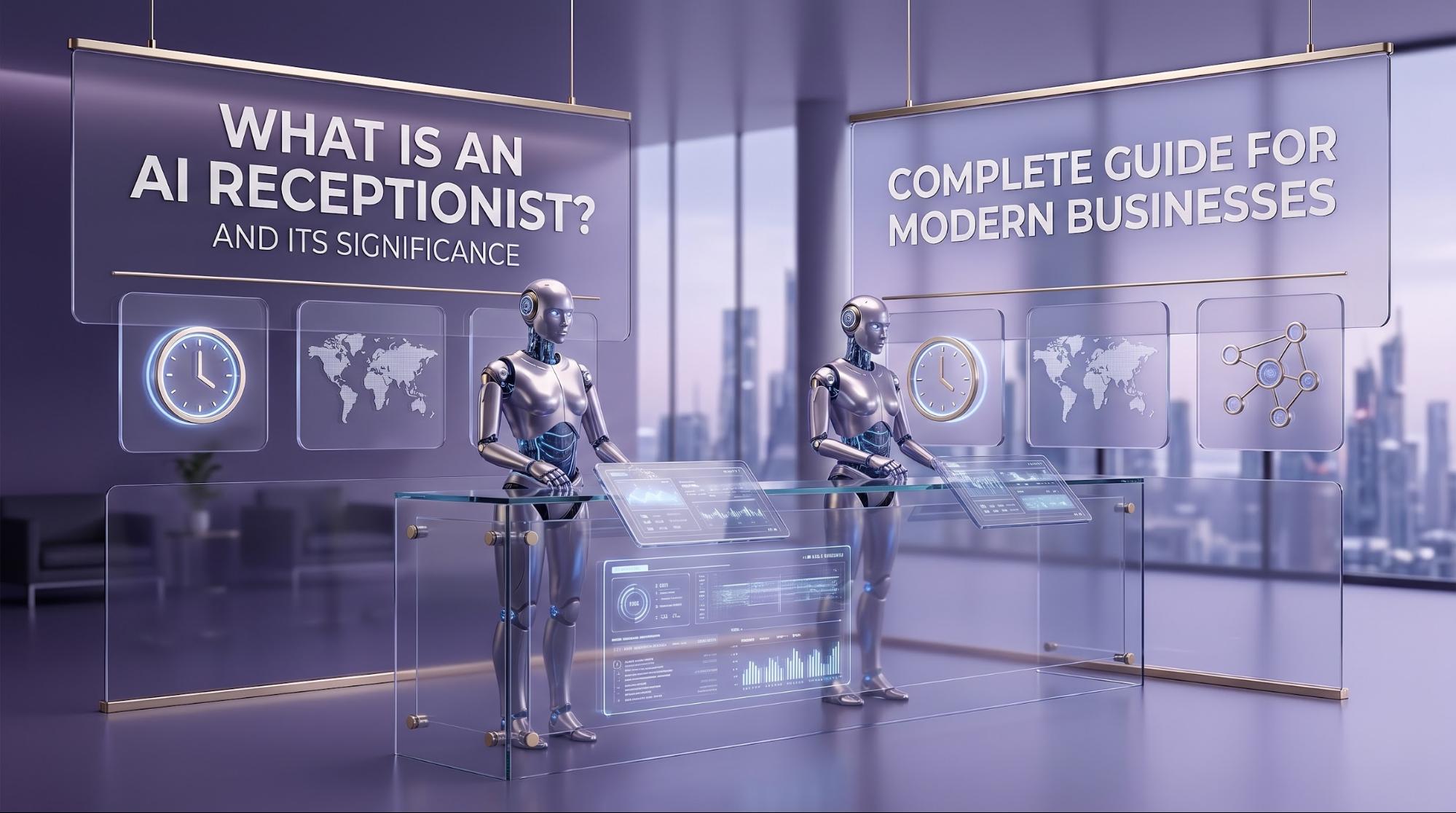
What Is an AI Receptionist? Complete Guide for Modern Businesses
Discover how an AI receptionist automates inbound calls, handles AI appointment scheduling, and offers a 24/7 answering service to scale your business.
Many businesses nowadays are moving towards digitalization and artificial intelligence in many aspects. However, a place where many small and medium-sized business owners are still reluctant is the front desk. The main reasons for sticking to a human receptionist are myths associated with robotic responses, monotonous call handling, and cost burden. But the facts are totally contrary to the perceptions. Although traditional receptionists are considered to be efficient in terms of emotional connectivity and human elements, they can never beat the advanced AI receptionists in terms of cost, customization, efficiency, availability, and accuracy. The following blog is a detailed guide to what virtual receptionists are, what their features and benefits are, and how these can be implemented in businesses.
What is an AI Receptionist
An AI receptionist is a conversational, voice-based virtual, human-free answering assistant trained on a Natural Language Processing Model and speech recognition to adapt to the dynamic environment based on the front desk requirements, answer phone calls, greet callers, understand their intent, and take action on their behalf.
Core Features of an AI Receptionist
The following are the core features of an AI receptionist.
1- Quick Responses with 24/7 Answering Service
First, AI receptionists operate 24/7/365 without vacations, breaks, sick days, or overtime pay. They answer calls in under 3 seconds on average, compared to 23 seconds for a human receptionist and often 45+ seconds for a traditional answering service. Because 85 percent of callers who reach voicemail never leave a message and 35-40 percent of calls come outside business hours, an AI receptionist ensures your business never loses the potential client, losing might will leave your growth three times slower than your competitors.
2- AI Appointment Scheduling
Next, AI receptionists automate your appointment scheduling and bookings without any hassle. It is actually interesting because the AI in itself checks your calendar, available slots, and available services, and then books clients on them directly. Humans, contrary to it, have to go through all schedules, updates calendar, and inform clients manually after multiple back-and-forth emails and phone calls, which not only takes time but also leads to the client loosing his interests. No matter if the request is as simple as a small haircut or as complex as planning the surgery of a patient, an AI receptionist instantly fetches information from your existing schedule and availability all at once and updates clients in no time, making the booking process smooth for everyone.
3- Smart Call Routing
Additionally, since not all clients are the same geographically and behaviourally, the AI receptionist figures out, with its advanced call routing properties, which specific person or department the caller needs to speak with based on their request. If it is a sales inquiry, the call is automatically routed to sales. Likewise, if it is a support query, AI call routing directs it to the support team. Not only this, an AI receptionist can even handle after-hours calls by directing them to voicemail or offering an emergency contact. This ensures calls reach the right destination quickly, improving precision, efficiency, and customer satisfaction.
4- AI Lead Capture
Moving further, AI Lead Capture allows the front desk assistant to gather required details like company name or interest in a specific product in no time by just asking for the caller’s name, number, and the reason for their call. Likewise, unlike humans who forget details, mishear names, and lose Post-it notes, the AI recalls every detail perfectly every time the previous customer comes in. In this way, it becomes extremely feasible to reach problem descriptions (verbatim transcription), preferred call-back times, and specific service requests.
5- CRM Automation
Last but not least, AI receptionists ask qualifying queries and score leads based on your business criteria. They capture all details of the inquiry, then leverage CRM Automation to deliver this information via email, SMS, or directly to your software. AI receptionists push data into systems like Salesforce, HubSpot, Zippier, and Cal.com—creating contacts, logging interactions, and updating records automatically.
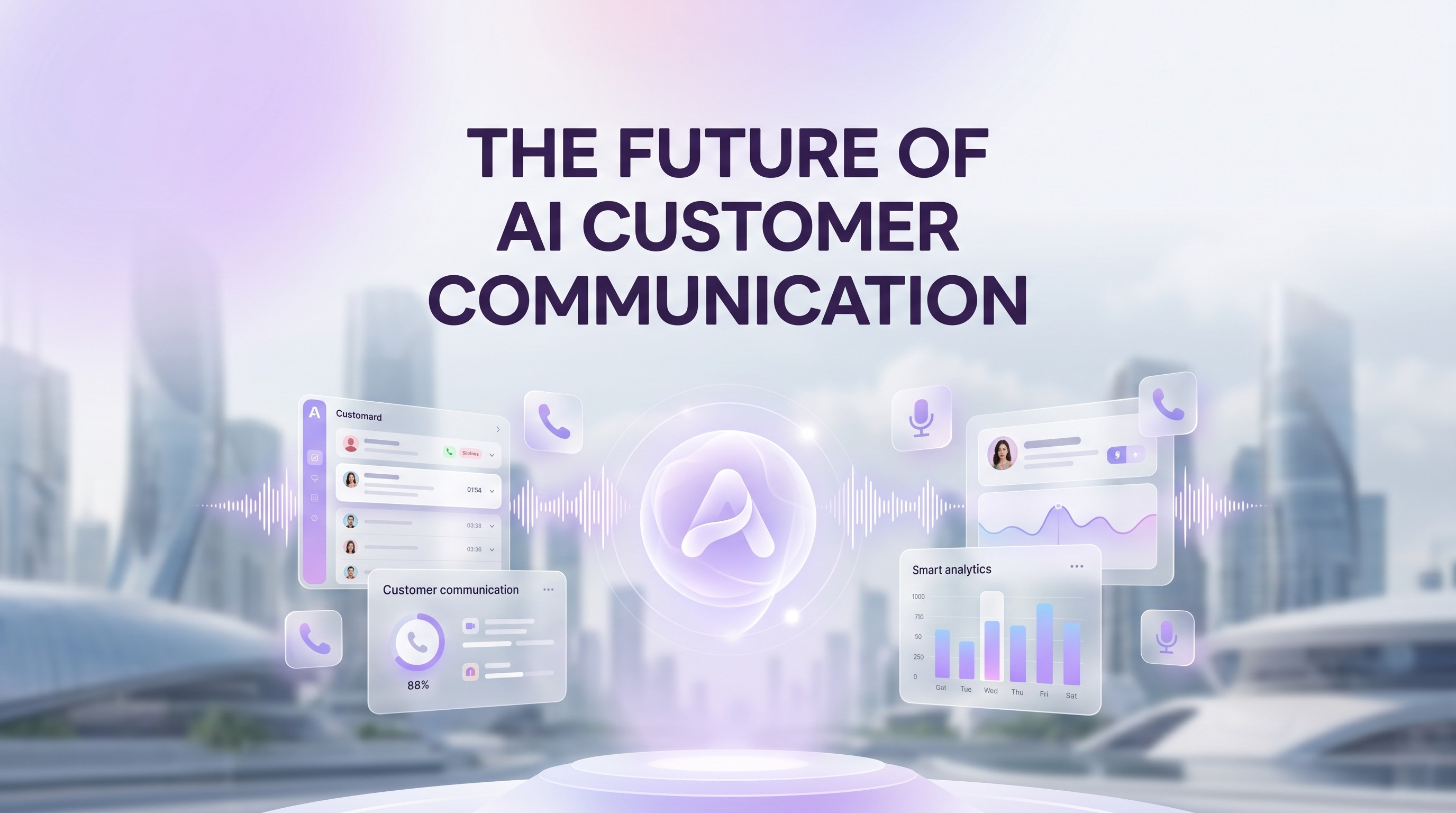
Benefits of an AI Receptionist for Modern Businesses
Along with the features, AI receptionists have various benefits for small and medium-sized modern businesses.
1- Reduces Operational Costs
The utilization of AI receptionists in businesses can drastically reduce the operational cost of a business. If the AI can take care of the busywork (even after hours), your teams save a lot of time and energy on overtime or extra front-desk coverage. Likewise, it saves you from hiring extra workforce for night duties and receptionist alternatives. Doing this, the automated AI answering system saves time and eases the workload, while callers still get a fast, professional response.
2- Eliminates Missed Calls
Every missed call is a missed opportunity, and for most businesses, those numbers add up painfully fast. Statistically, the average business misses 22% of incoming calls. At $200-500 per lead, that’s thousands in lost revenue monthly. The gap is filled by an AI receptionist that plugs this massive revenue leak by ensuring your business is constantly available. Whether it is a chaotic Monday morning rush, 3:00 AM on a Tuesday, or a major national holiday, the system answers instantly. It captures every single lead, qualifies the prospect, and secures the business before they can wander off to someone else.
3- Improves Customer Response Time
Additionally, in the modern market, speed is the ultimate competitive advantage because consumers expect immediate gratification. When a customer calls with a question or wants to book a service, even a ten-minute delay in response can cause them to lose interest or look elsewhere. An AI receptionist completely rewrites this dynamic by delivering instantaneous engagement. There are no hold music loops, no tedious routing menus, and no delayed call-backs. The system greets callers immediately, processes their requests in real-time, and provides accurate information on the spot. This hyper-responsive communication style not only keeps anxious prospects from abandoning the call but also signals to the customer that your business is sharp, organized, highly reliable, and deeply respectful of their time.
4- Increases Booking Rates
If a client is calling your receptionist, he is already half-interested. But after scheduling the appointment, he might forget about his bookings due to busy schedules. Research statistics show that 196,018 dental appointments were made, and found that 20% ended in no-shows. In that case, you can make it easy for potential customers by sending automated reminders via your virtual AI scheduling assistant. This continuous, automated touchpoint bridges the gap between a client making an appointment and actually showing up, drastically reducing the risk of empty slots and ensuring your calendar stays consistently full and profitable.
5- Enhances Lead Conversion
A lead is only valuable if it actually converts into a paying customer, and consistent follow-up is the key to making that happen. Implementing automated reminders via voice, text, and email works to aggressively reclaim revenue that would otherwise be lost to simple human forgetfulness. For instance, per the stats, by eliminating no-shows, automated reminders sent via SMS, email, and voice reduce no-shows by up to 87%. Similarly, for a business with 100 appointments/month and a 20% no-show rate, that’s 17 recovered appointments monthly. The dramatic optimization directly stabilizes your monthly cash flow without requiring you to spend an extra dime on marketing or customer acquisition. The AI effectively maximizes the value of the traffic you already have, turning casual inquiries into guaranteed revenue with zero manual effort from your staff.
Tips for Choosing and Setting up the Right AI Solution
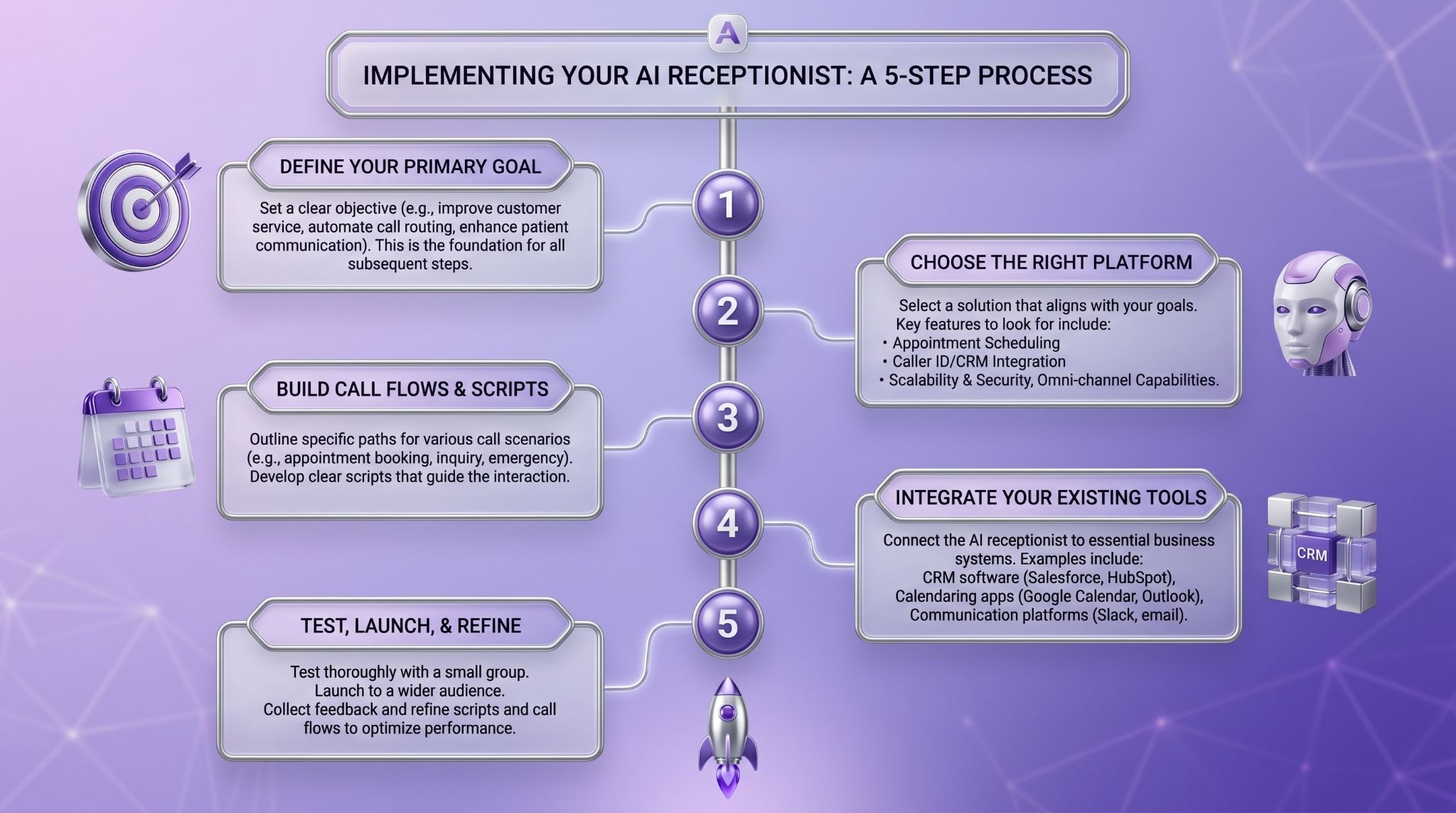
Getting an AI receptionist live is more straightforward than most people expect. You don't need a tech background or a long implementation project. Here's how to do it in five stages.
Step 1: Define one clear, primary goal for your AI receptionist, such as booking appointments, answering FAQs, qualifying leads, or providing 24/7 support. to guide every software and configuration decision that follows.
Step 2: Choose a platform that specifically aligns with your primary objective, leveraging free trials and demos to find an intuitive, plug-and-play solution with the exact calendar or CRM integrations your business requires.
Step 3: Use the platform’s drag-and-drop editors to map out a simple, code-free call flow and script that gives your AI personality while focusing strictly on resolving your most common caller scenarios.
Step 4: Integrate the AI receptionist with your existing calendar, CRM, and email systems to create a hands-off background workflow that automatically schedules appointments and logs fresh lead data.
Step 5: Call the system yourself to test various customer scenarios before launching, then review call recordings weekly to make minor script tweaks based on real user behaviour.
Conclusion
In a nutshell, an AI receptionist is one of the most sagacious transformations modern businesses can go for. Audiva.AI provides its customers with all the benefits that a business can ask for when it comes to switching to the AI receptionist on the front desk. It ensures 24/7 availability, quick and customized response to the clients anytime, and automated appointment scheduling.
FAQs Section
What is the difference between an AI receptionist and a live virtual receptionist?
An AI receptionist uses conversational software to instantly interact with callers, automate routine tasks, and operate 24/7. A live virtual receptionist can be a real person working remotely who provides a personalized, human touch for complex inquiries.
How can an AI receptionist help reduce missed calls?
AI receptionists answer calls instantly and ensure that every inquiry is captured and handled. In this way, it helps reduce missed calls, improve response times, and increase the chances of converting inquiries into confirmed bookings. By responding quickly, businesses can capture more leads and keep their appointment calendar full.
Is conversational AI effective for handling complex customer service issues?
Modern AI receptionists handle most routine conversations efficiently, including appointment booking, FAQs, lead qualification, and basic troubleshooting. The hybrid approach ensures efficiency for standard calls and expert care for critical problems.
Can AI receptionists integrate with existing CRM automation tools?
Absolutely; high-quality AI receptionists can deeply integrate with major CRM and business automation tools via direct APIs. This creates a hands-off system where the AI automatically updates contact data, logs call notes, and pushes new leads directly into your sales pipeline.
How does AI appointment scheduling eliminate double bookings?
AI appointment scheduling connects directly to your calendar in real-time, instantly blocking off secured time slots so no overlap can occur. It also sends automated confirmations and reminders, significantly reducing no-shows and keeping your schedule accurate.
About The Author

Ibrahim
CEO/Founder



Background Story



Related Articles

features/24 7 Availability
Why Businesses That Answer First Win More Customers
Answer every call, day or night. Learn how AI call handling helps businesses respond faster, capture more leads, and convert more customers 24/7.
Ibrahim

features/24 7 Availability
The Hidden Cost of Missed Business Calls for a Business
Missed calls may cause significant revenue loss for a business. Thus, an AI receptionist is a must to handle all these missed calls with 24/7 automation to capture every lead.
Ibrahim

Ready to See Audiva in Action?
Reading about AI receptionists is one thing. Hearing one handle a real call is something else.