What is AI-enabled Customer Communication Call Handling?
The rising Artificial Intelligence has changed the trends of customer communication from manual human call handling to the very efficient AI customer service.
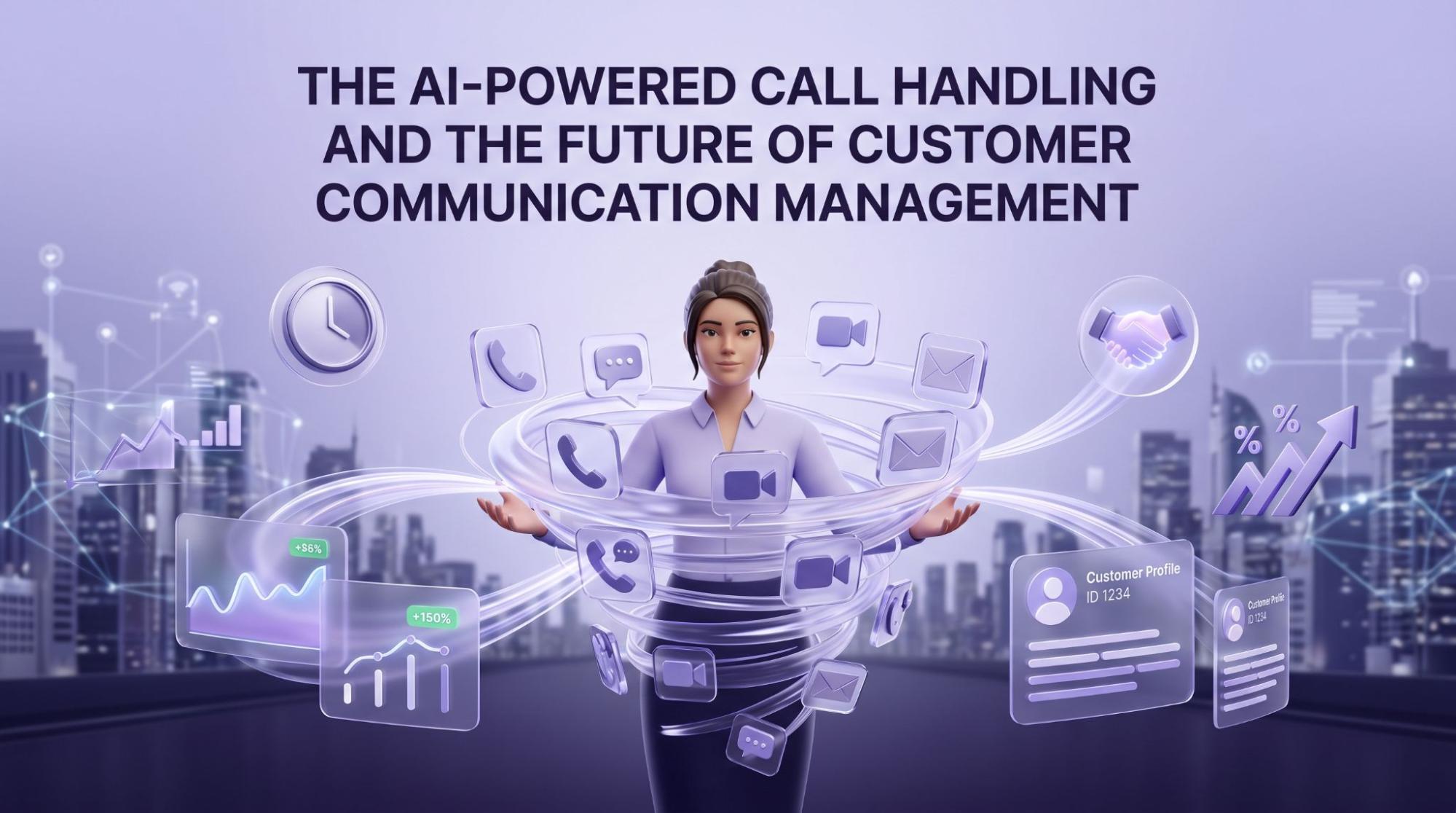
Gone is the era when businesses used to wait for customers to struggle and then initiate contact. With the advent of the fifth wave of advanced technology, customer communication management trends are evolving quickly, transitioning from a basic chat interface to proactive artificial intelligence customer service. So, the organizations, rather than reaching out to their customers manually and missing many calls, are using AI customer experience platforms to drive retention and measurable business value. Thus, the use of AI in customer service is no longer a luxury; companies using AI for customer service are seeing a distinct competitive advantage. Such an AI-powered call handling model provides customers with more personalised experiences, quick responses, and the ability to communicate across multiple channels. On the other hand, companies that fail to adapt risk losing to competitors using advanced technologies and data-driven strategies. The following blog provides a clear manifestation of the utilization of AI-powered call handling for clients as the future of customer communication management for businesses
The Importance of Effective Customer Communication Management
For any business’s success, the most important thing is effective communication with the client, as it is the first confrontation of clients with the dealer. This can make or mar the conversion of first-time communicators to actual repetitive leads. Successful communication is one in which customer service and AI integration ensure that communication understands customer behaviors and responds in client-friendly terms. According to Gartner, by 2026, customer service automation AI is projected to reduce agent labor costs by $80 billion annually, proving that efficiency is now a fiscal mandate. CGS Nexus data indicates that roughly 70 percent of consumers now view fragmented service (e.g., repeating information to a phone agent that was already discussed via chat) as a significant failure of the company and expect the company to know their full interaction history across all channels without being prompted. That is why market leaders have fully adopted modern technology, with more than 80 percent of their routine customer queries now handled by AI customer service bots. Thus, it is no longer enough for an AI communicator to be fast; it must be personalized, tonally aware, linguistically and culturally sensitive, and tailored to the specific emotional state or previous behavior.
The Future of Customer Communication Management with AI-Powered Call Support
The landscape of customer interaction is undergoing a profound transformation, driven by the relentless advancement of Artificial Intelligence. As businesses strive to meet ever-increasing customer expectations for speed, personalization, and smooth support, AI for customer care and AI-enabled call services are emerging as indispensable tools at the forefront of the communication evolution in businesses. These intelligent systems are not merely replacing human agents; they are augmenting capabilities via an AI-powered contact center that redefines efficient communication.. Hence, the best call-AI solutions on the market offer businesses the ability not to be left behind in the race of automated communication management.
1. Interactive and Hyper-Personalized Communications
One of the biggest advancements in AI in customer care is the rise of hyper-personalized communication. McKinsey reports that companies that excel at personalization with modern customer service AI software generate 40% more revenue from those activities than average players, highlighting the direct link between AI voice solutions and the bottom line. Let's take an example of medicine field. If a returning customer calls a healthcare clinic, an AI voice receptionist can instantly recognize the patient, access appointment history, verify insurance details, and provide customized scheduling options without requiring the patient to repeat information multiple times. Similarly, in hospitality, AI voice systems can remember guest preferences such as room types, dining preferences, or language settings. Thus, whether it is an AI customer service agent in a clinic or a commercial AI voice in hospitality, these systems remember preferences to create smoother experiences.
2. Predictive Engagement and Real-Time Agent Assist
Additionally, the future of AI customer service solutions is not limited to reactive support. AI systems are increasingly becoming predictive. Rather than waiting for customers to report problems, an AI customer service platform can proactively identify potential issues and contact customers before frustration occurs. For instance, if an internet service outage occurs in a specific region, an AI customer service chat can automatically notify affected customers, explain the issue, provide estimated resolution times, and reduce incoming support calls before call volumes spike. Thus, the predictive engagement model in assist AI provides human agents with real-time suggestions, ensuring the AI communicator and the human agent work in tandem.
3. 100% Interaction Transparency and Quality Assurance
Traditional call centers have long struggled with quality monitoring limitations. Most organizations historically reviewed only 1–5% of customer calls for quality assurance, leaving significant blind spots in customer experience management. Modern AI customer service AI companies change this completely. Using Natural Language Processing (NLP), an auto-calling system or a calling platform can now analyse 100% of customer interactions across various channels in real time. In a field experiment covering 10,000 interactions, AI-driven sentiment analysis accurately identified frustration at a high rate, while preventive recovery actions led to a 43% reduction in formal complaints and a 19% increase in 90-day retention. Likewise, organizations adopting AI-driven contact centre automation are reporting operational cost reductions between 65% and 90%, alongside improved First Call Resolution rates and faster customer response times. Additionally, AI-powered quality monitoring helps businesses maintain consistency across every interaction so that customers receive accurate and professional communication regardless of call volume, business hours, or staffing limitations.
4. Communication Synchronization across all Your Channels
Modern customers do not communicate through just one platform. They utilize multiple platforms: might discover a business through social media, ask questions through live chat, call for support, and follow up via email or SMS. This creates a major challenge for businesses using disconnected communication systems. AI-powered contact centre solutions solve this problem by synchronizing customer interactions across all channels. An advanced AI voice conversation can integrate with CRM systems, Calendars, Help desk software, SMS platforms, and Payment systems. It, as a result, creates a unified customer journey where information flows smoothly between platforms, eliminating the frustration of repeating information across an AI customer service bots interface and a live AI voice solution.
5. Integration of Multilingual Support and cultural sensitivity into your customer communications
Likewise, for businesses operating in a globalized world, language barriers have historically presented a significant challenge, often necessitating expensive and complex regional call centres. However, advanced AI platforms are revolutionizing this aspect of customer service. These cutting-edge solutions now support AI voice conversation in over 200 languages and accents. This monumental capability allows a single AI customer service platform to serve a truly global audience with localized, culturally sensitive commercial AI voices, entirely eliminating the need for a multitude of regional call centres. For example, a customer in Japan can speak in Japanese, and the AI instantly translates it into English for an agent (or directly processes it if fully automated), and then translates the response back into Japanese, all in real-time. Industry-wise, a real estate company can handle inquiries from international investors in multiple languages, and a medical practice can support patients who speak Urdu, Spanish, Arabic, or Mandarin without hiring separate language-specific receptionists. The AI can even adapt its tone and linguistic nuances to align with cultural expectations, fostering a deeper connection and understanding.
Audiva. AI: Helping Businesses to Ride the Wave of Customer Communication Trends
The future belongs to businesses that communicate intelligently. This is where Audiva AI helps. As one of the leading AI customer service companies, Audiva AI provides an intelligent system that combines 24/7 answering, appointment scheduling, and lead qualification. Furthermore, rather than functioning like a basic auto-calling system, Audiva AI acts as a fully integrated AI customer service agent capable of handling customer interactions naturally and professionally in almost all businesses, including healthcare, hospitality, real estate, insurance, legal services, or home services.
Conclusion
To sum, he future of customer communication management is being shaped by AI-powered contact centre technology and customer service automation AI, which continue to evolve rapidly. Businesses are moving beyond traditional customer service models toward customer service automation AI that is personalized, predictive, secure, and autonomous. Although companies remain thoughtful about implementation, it is a matter of fact that what once felt futuristic is quickly becoming part of everyday business operations, and businesses that embrace intelligent AI customer service solution technologies today, from AI chat support to commercial AI voice, will be far better positioned to meet tomorrow’s customer expectations.
About The Author

Ibrahim
CEO/Founder



Background Story




Related Articles

features/24 7 Availability
Why Businesses That Answer First Win More Customers
Answer every call, day or night. Learn how AI call handling helps businesses respond faster, capture more leads, and convert more customers 24/7.
Ibrahim

features/24 7 Availability
The Hidden Cost of Missed Business Calls for a Business
Missed calls may cause significant revenue loss for a business. Thus, an AI receptionist is a must to handle all these missed calls with 24/7 automation to capture every lead.
Ibrahim

Ready to See Audiva in Action?
Reading about AI receptionists is one thing. Hearing one handle a real call is something else.