How AI Receptionist benefit Businesses?
Learn 5 Ways an AI Receptionist Benefits a Growing Business and Replaces Traditional Phone Answering Services
5 Ways an AI Receptionist Benefits a Growing Business
The missed calls problem is one of the most consistently under-addressed revenue leaks in growing businesses. It not only halts the incoming customers to your businesses but also directs the missed clients towards your competitors. There has been rhetoric about which model would actually help businesses grow better: a traditional call answering service with a human agent or an AI receptionist that does not let any customer move away from your services by understanding requests and booking all appointments in real time. The following blog covers what an AI assistant for business is, its functionalities, potential, cost, and its limitations. Moreover, it gives a thorough assessment of why and how AI has a genuine capability to surpass human agent answering services.
What Is an AI Receptionist?
For businesses, an AI assistant or AI voice chatbot is a 24/7 virtual, conversational AI tool that uses natural language processing (NLP) and speech recognition to handle business phone calls and communications for all kinds of businesses: healthcare, dental clinics, real estate, home services, etc. It, in fact, is an AI business automation model that functions as a voice assistant for business, addressing calls instantly, answering FAQs, scheduling appointments, and routing inquiries to the correct staff. In a line, it acts as a tireless, cost-effective alternative to traditional human front-desk staff.
Difference between an AI virtual Business Assistant and a Human Receptionist
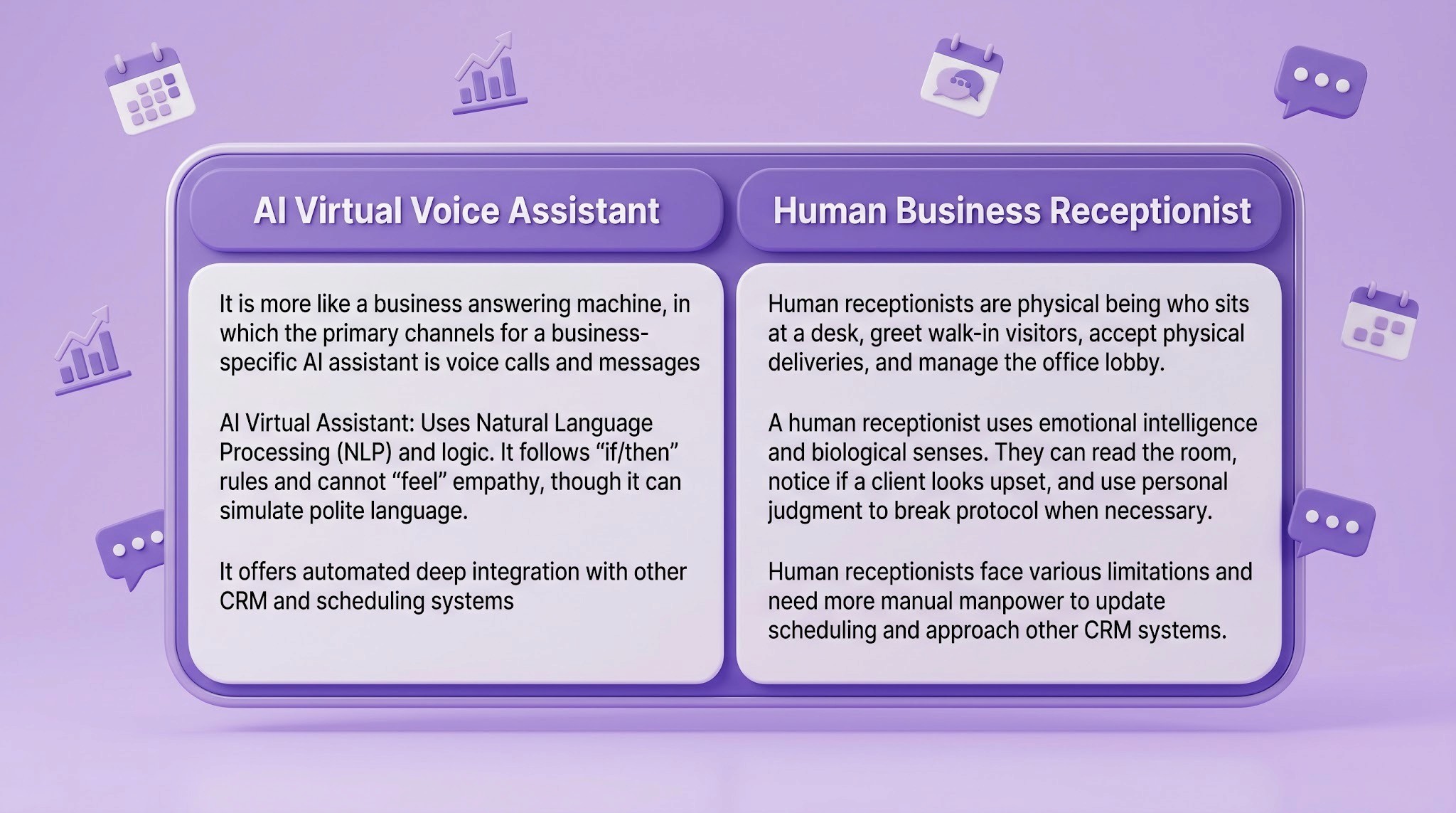
AI Virtual Voice Assistant | Human Business Receptionist |
It is more like a business answering machine, in which the primary channels for a business-specific AI assistant is voice calls and messages | Human receptionists are physical being who sits at a desk, greet walk-in visitors, accept physical deliveries, and manage the office lobby. |
AI Virtual Assistant: Uses Natural Language Processing (NLP) and logic. It follows "if/then" rules and cannot "feel" empathy, though it can simulate polite language. | A human receptionist uses emotional intelligence and biological senses. They can read the room, notice if a client looks upset, and use personal judgment to break protocol when necessary. |
It offers automated deep integration with other CRM and scheduling systems | Human receptionists face various limitations and need more manual manpower to update scheduling and approach other CRM systems. |
5 Ways an AI Receptionist Benefits a Growing Business
In today’s tech-led market, small businesses and growing companies are continuously yearning to use AI for business automation to speed up client handling, streamline operations, and improve customer satisfaction, along with the reduced cost headache.
Here are the five ways in which an AI virtual receptionist, powered by ai business software, is superior to the traditional telephone answering service business to help it growth
1- 24/7 Availability Without the Overtime Pay
First, an AI receptionist surpasses a human front-desk assistant due to its uninterrupted availability. With a customized automated voice message for business and multiple clients handling features, the AI receptionist resolves all problems of a human assistant, transitioning from a 9-to-5 framework to a 24/7 never-sleeps model. According to the recent report of the Deloitte 2026, AI interactions cost between $0.25–$0.50, compared to $3.00–$6.00 for human agents. Thus, AI business software agents capture after-hour leads while competitors are online and handle even holiday and weekend surges without increasing headcounts
2. Instant Lead Conversion and "Zero-Wait" Service
Next, the AI receptionists boost businesses' growth with immediate responses and instant lead conversion. Since the response time is the number one predictor of conversion, moving to an automated AI phone answering business service can reduce response time from 24 hours to 5 minutes, yielding a 32% ROI in lead-to-appointment conversion. On the other hand, waiting just 30 minutes to respond makes you 21 times less likely to qualify a lead compared to responding within 5 minutes. Likewise, per Blazeo's data, 62.5% of AI-using companies meet the under-15-minute response standard with 39.1% of manual-only businesses meeting the same standard. Thus, an AI chatbot for business or a voice assistant for business can sync directly with CRMs to book appointments instantly, ensuring zero-wait service.
3. Eliminating the "Small Business" Stigma with Exceptional Professionalism
Using a business phone greeting script and a customized AI voice receptionist sounds like a Fortune 500 company. Often, only large companies seek Google Voice for businesses or business voice mail service. Contrarily, small businesses avoid it, thinking it is costly and unapproachable. Many studies show how specialized AI for business automation provides a big brand feel not only to the businesses but also to the clients who get services from those small setups.
4. Drastic Operational Cost Reductions
Moving further, as mentioned above, many small businesses think that transitioning from a human receptionist to an AI automated voice receptionist, with various added integrations, can not only streamline the SMEs' clients but also drastically reduce the front-desk cost. One human with limited physical and mental availability can cost you more than double as compared to an AI business assistant that neither sleeps nor needs further assistance, along with almost no chance of mistakes and mishandling. Let's take, for example, a US company. It needs saving for up to $250,000 over five years compared to hiring a full-time human receptionist. And using AI can cause a 35-50% reduction in front-desk operational costs
5. Seamless Scalability and Data Integration
Last but not least, AI, unlike humans, can handle 10,000 cases as easily as once. Now the businesses, therefore, are moving towards agentic AI that has become a trend. The agentic AIs are autonomous systems that do not just talk but actually do. ( for example, porting business phone numbers or updating billing). Moreover, the AI model provide SMBs with numerous integrations, automating the whole scheduling and adapting with all other apps. The service would be so disseminated in businesses to the grassroots level that its market is projected to reach 14.6 billion USD by 2030, growing at a 24.3% CAGR.
Conclusion
In sum, AI receptions solve real operational problems without replacing brand voice. It stays supreme over human agents owing to 24/7 access, uninterrupted lead capture, business professional image, cost reduction, and scalability. The goal is not to replace the human touch front he whole businesses but to ensure no customer is left in the dark and no business lags due to human limitations.
About The Author

Ibrahim
CEO/Founder



Background Story



Related Articles

features/24 7 Availability
Why Businesses That Answer First Win More Customers
Answer every call, day or night. Learn how AI call handling helps businesses respond faster, capture more leads, and convert more customers 24/7.
Ibrahim

features/24 7 Availability
The Hidden Cost of Missed Business Calls for a Business
Missed calls may cause significant revenue loss for a business. Thus, an AI receptionist is a must to handle all these missed calls with 24/7 automation to capture every lead.
Ibrahim

Ready to See Audiva in Action?
Reading about AI receptionists is one thing. Hearing one handle a real call is something else.